A Rainy-Day Rewatch for Listening to a Room
A rainy-day rewatch for listening to a room reveals how off-screen sounds make an interior feel active, inhabited and larger than the frame.
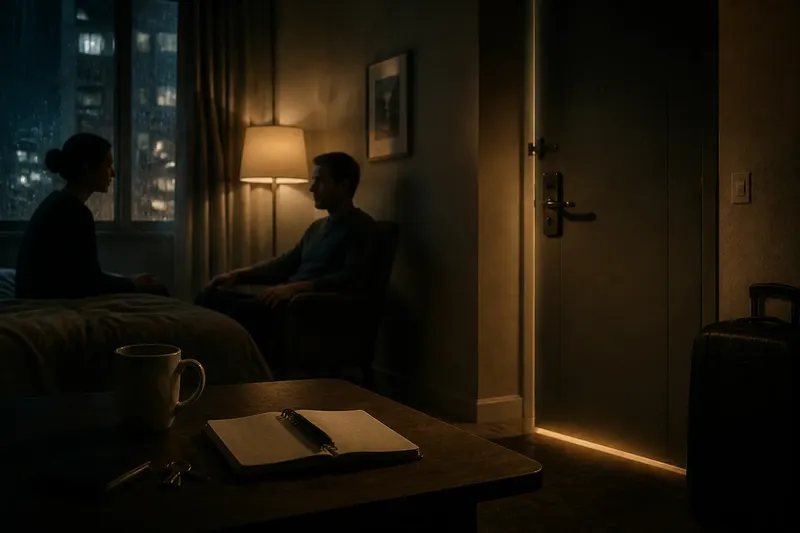
A rainy-day rewatch for listening to a room can reveal a film’s unseen activity more clearly than another close look at the image. Choose one interior scene, keep your attention on its sound, and notice how footsteps, pipes, muffled voices or a chair shifting suggest lives and actions beyond the frame.
What should I listen for in a room scene?
Listen for sounds that imply a cause, a location or a change in activity. A kettle beginning to hiss suggests someone has set it on; footsteps fading into a corridor suggest movement away from the visible characters. The sound need not identify its source precisely. A vague thump may matter because it makes the adjoining space feel occupied.
On the first pass, watch normally and choose a scene with a clear interior boundary: a kitchen, office, hotel room or waiting area. On the next pass, look away from the screen or close your eyes for a short stretch. This makes it easier to distinguish what the soundtrack tells you from what the image supplies.
Notice the scene’s steady bed of sound as well as its distinct events. A radiator’s uneven ticking, distant traffic through glass or the soft electrical hum of a fluorescent light can make the room seem connected to a building and a neighbourhood. Silence can be constructed, too: a sudden absence of ambient sound may make a pause feel unusually exposed.
How do off-screen sounds make the room feel larger?
Off-screen sound extends a scene beyond the camera’s boundaries by giving the viewer evidence of spaces that are not shown. A lift bell outside an office, a conversation through a wall or footsteps above a bedroom can suggest a corridor, another floor or a neighbouring room without cutting away to it.
Ask where you imagine each sound coming from, then check whether the film gives you enough clues to keep that impression. Reverberation can make a hallway seem hard and enclosed; a dry, close voice may feel as if it comes from just outside the door. These clues are not a floor plan, but they establish a workable sense of distance and direction.
The frame and soundtrack can also disagree. If a character listens towards a closed door while faint movement continues behind it, the room becomes a place of uncertainty: someone may be nearby, but the scene withholds their identity. That gap between sound and sight lets the story create expectation without adding another image.
How can I tell whether a sound belongs to the setting or the score?
Ask whether the sound seems to have a plausible source within the scene. A spoon tapping a mug, a window rattling or water moving through pipes usually reads as part of the setting. A sustained musical tone that follows a character’s fear or relief is more likely to belong to the score, even if it resembles a hum or a drone.
Some sounds sit between those categories. A low rumble might be a train outside, a musical effect or a designed blend of both. Rather than forcing a definite answer, note what the uncertainty does: it may make the room feel threatening, unstable or simply difficult to read.
Listen for how a sound changes with the scene. If a hum continues at the same level while the characters move and speak, it may be part of the ambient bed. If it swells with a glance or a revelation, it may be serving the emotional shape of the moment. Films often combine these approaches, so the most useful observation is what the sound directs you to feel or expect.
What should I note during a focused rewatch?
A few concise observations are more useful than a complete inventory. Record sounds that alter your sense of who is present, what is happening elsewhere or how the room feels. Then compare those notes with the image: did the film confirm your inference, leave it open or redirect it?
- Source: Is the sound recognisable, ambiguous or impossible to place?
- Distance: Does it feel close, behind a barrier or far away?
- Direction: Does it seem to come from the left, right, above, below or outside the room?
- Timing: Does it begin before a character reacts, or after the image has drawn your attention elsewhere?
- Change: Does it stop, grow louder or become masked by dialogue or music?
- Story effect: Does it suggest routine, interruption, privacy, danger or a presence the image withholds?
Say you choose an invented scene in which two people speak in a dim hotel room. On a second listen, you hear a trolley rattling past and stopping somewhere outside the door; the expected result is a stronger sense of hotel activity, even though nobody enters the shot. If the trolley moves on without a knock, that small event may also make the conversation feel private again.
Why do ordinary room sounds matter to character and mood?
Everyday sounds make a scene’s activity feel continuous rather than arranged only for the camera. A character who keeps talking over a running tap seems to be doing something alongside the conversation; a sudden pause in the same sound can make attention shift towards an interruption. The sound gives the dialogue a surrounding routine.
It can also shape a room’s mood without announcing that mood. A clock ticking in a quiet waiting room may sharpen a sense of delay, while distant voices in a corridor can make a character’s isolation feel temporary or fragile. Like the ticking of a kitchen clock that you stop noticing until it falls silent, an ambient sound can become meaningful through its absence.
These details are not a shortcut to a single interpretation. The same ventilation hum might suggest comfort in one scene and confinement in another, depending on the performance, framing and what has just happened. Treat your response as a reading of the film’s choices, not as a fixed code.
How long should I spend listening to one scene?
Stay with the scene until you can describe its main sound layers and one change in them. That may take only a couple of attentive passes; a complicated sequence may reward another. The aim is not to count every noise, but to hear how sound organises attention across the scene.
For a final pass, restore the image and watch the same section without pausing. Notice which sound now feels newly prominent and whether your imagined space matches what the film actually reveals. This last comparison is where the rainy-day rewatch for listening to a room becomes useful: you return to the whole scene with a clearer sense of what its edges contain, and what they deliberately leave out.